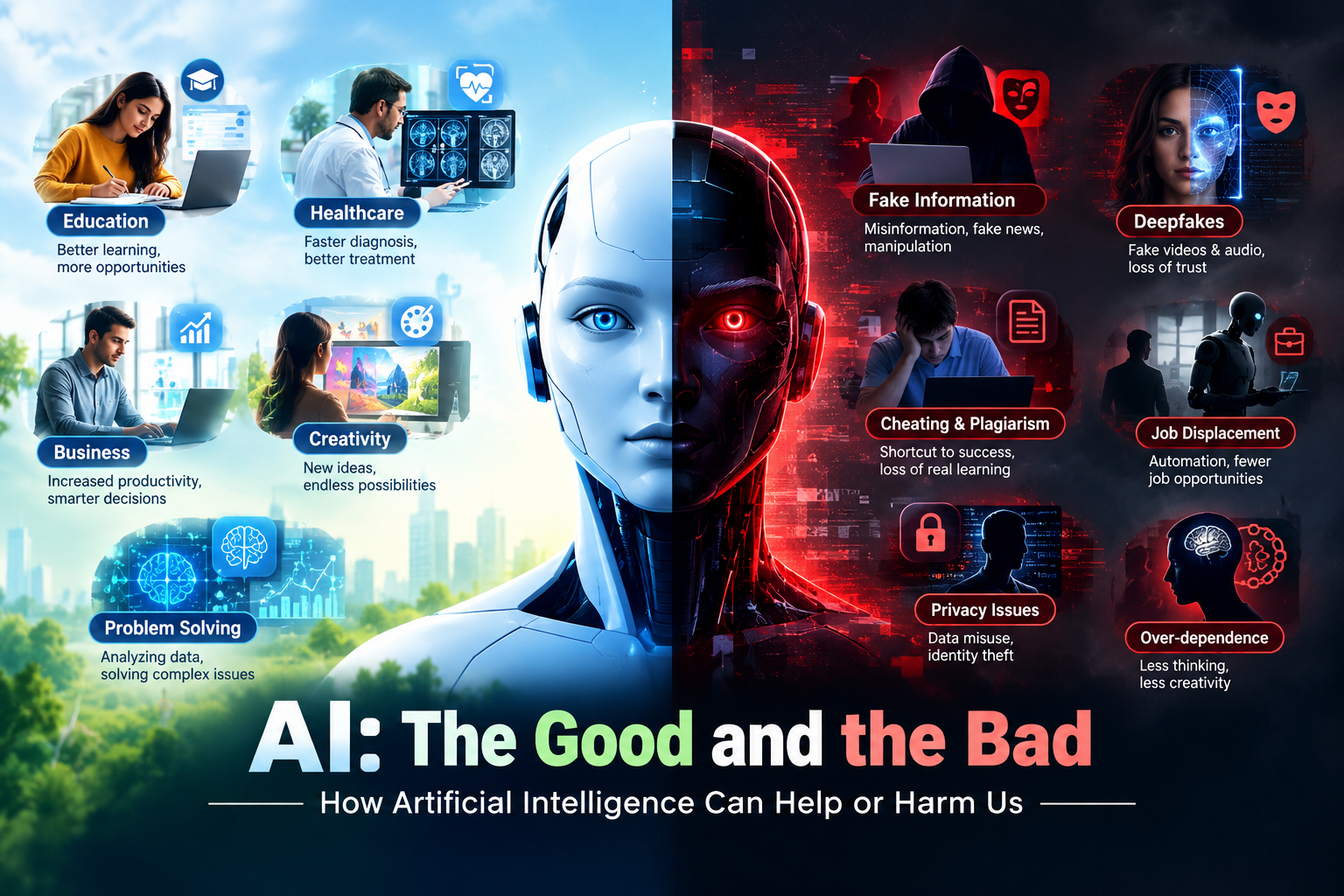
Artificial Intelligence (AI) has become an important part of our everyday lives. From helping students learn and businesses grow to creating images, videos, and content, AI is making many tasks faster and easier. It can analyze huge amounts of information, solve complex problems, and help people make better decisions.
However, like any powerful technology, AI also has a darker side. The same technology that can help people can also be misused to create fake information, deepfakes, scams, plagiarism, and other harmful content. Overdependence on AI can also affect human creativity, critical thinking, and some jobs.
So, is AI good or bad? The answer depends largely on **how we choose to use it. In this blog, we will explore both the positive and negative sides of Artificial Intelligence and understand how AI can be used as a powerful tool for good while avoiding its harmful and irresponsible uses.
AI Can Be Both Right and Wrong
Artificial Intelligence is one of the most powerful technologies of the modern world. It has changed the way people learn, work, communicate, and solve problems. However, AI is neither completely good nor completely bad. Its impact depends on the way people create, control, and use it. Like any other powerful tool, AI can be used for helpful purposes as well as harmful activities. Therefore, it is important to understand both sides of AI and use it with responsibility, honesty, and common sense.
AI can be extremely useful in education. Students can use AI to understand difficult topics, improve their grammar, translate languages, prepare study notes, and receive explanations in a simple way. Teachers can also use AI to create lesson plans, quizzes, and learning materials. However, the same technology can be used in the wrong way. Some students may copy complete assignments from AI without understanding the subject or developing their own ideas. This may save time, but it can reduce creativity, knowledge, and problem-solving skills. Students should use AI as a learning assistant, not as a shortcut for avoiding hard work.
AI is also helping doctors and hospitals. It can analyze medical reports, identify possible diseases, organize patient information, and support doctors in making better decisions. In businesses, AI can save time by handling repetitive tasks, answering customer questions, and analyzing large amounts of data. It can also help creators generate ideas, write drafts, edit images, and produce videos. These uses show how AI can improve productivity and create new opportunities. However, AI should not replace human judgment, especially in important areas such as healthcare, education, law, and finance.
At the same time, AI can be misused to create fake news, deepfake videos, false images, scams, and misleading information. A person can use AI to imitate someone’s voice or face without permission, damage another person’s reputation, or manipulate people online. AI can also create privacy risks when users share personal, financial, or confidential information with unknown tools. In addition, automation may affect some jobs, especially those involving repetitive tasks. These problems do not mean that AI should be completely rejected, but they show that proper rules and responsible behavior are necessary.
The right way to use AI is to treat it as a tool that supports human intelligence rather than replacing it. People should check important information before trusting or sharing it. They should respect copyright, privacy, and the permission of others. AI-generated content should not be presented as completely original when it is not. Users should also avoid using AI for cheating, fraud, harassment, or any illegal activity. Human creativity, emotions, values, and decision-making should remain at the center of every important task.
In conclusion, AI can be both right and wrong depending on how it is used. It can help society grow, improve education, support healthcare, and make daily work easier. At the same time, careless or dishonest use can create confusion, privacy problems, and social harm. The future of AI depends not only on its technology but also on the responsibility of its users. If we use AI with knowledge, honesty, ethics, and common sense, it can become a powerful tool for building a smarter, safer, and better future.
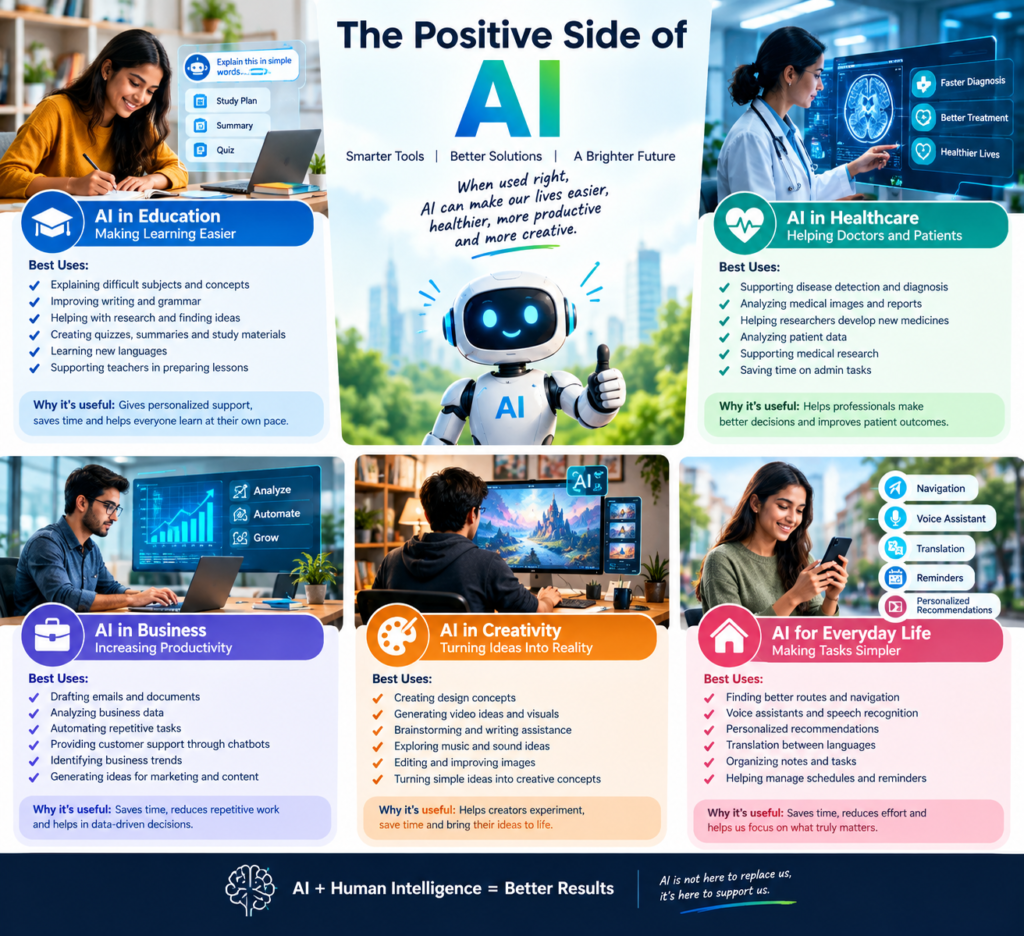
Artificial Intelligence is not only about automation and technology. When used correctly, AI can make our lives easier, help us solve problems, improve productivity, and create new opportunities. Here are some of the best ways AI can be used for positive purposes.
Artificial Intelligence has the potential to make our lives easier, faster, and more productive when it is used responsibly. AI can help students understand difficult subjects, assist doctors in analyzing medical information, help businesses automate repetitive tasks, and support creators in generating new ideas and content. It can also make everyday activities such as translation, navigation, scheduling, and information searching more convenient. One of the biggest advantages of AI is its ability to process large amounts of information quickly and provide useful assistance. When combined with human knowledge, creativity, and decision-making, AI can become a powerful tool for solving problems and creating new opportunities.
1. AI in Education — Making Learning Easier
AI can be a powerful learning assistant for students, teachers, and educators. Instead of simply giving answers, AI can explain difficult topics in simple language and provide personalized learning support.
Best Uses:
Best Uses:
📚 Explaining difficult subjects and concepts
✍️ Helping students improve their writing and grammar
🔍 Helping with research and finding ideas
🧠 Creating quizzes, summaries, and study materials
🌍 Helping students learn new languages
👨🏫 Supporting teachers in preparing lessons and educational content
Why it is useful:
AI can give students quick access to learning support and allow them to learn at their own pace. However, students should use AI as a learning assistant rather than a shortcut for completing their work.
2. AI in Healthcare — Helping Doctors and Patients
One of the most valuable uses of AI is in healthcare. AI can analyze large amounts of medical information and assist healthcare professionals in identifying patterns that may be difficult to notice manually.
Best Uses:
🏥 Supporting disease detection and diagnosis
🩺 Analyzing medical images and reports
💊 Helping researchers develop new medicines
📊 Analyzing patient data
🔬 Supporting medical research
⏱️ Saving time on repetitive administrative tasks
Why it is useful:
AI can help healthcare professionals process information faster and support better decision-making. It is most useful when it assists trained professionals rather than replacing human expertise.
3. AI in Business — Increasing Productivity
Businesses can use AI to automate repetitive tasks and help employees focus on more important and creative work.
Best Uses:
📧 Drafting emails and documents
📊 Analyzing business data
🤖 Automating repetitive tasks
💬 Providing customer support through chatbots
📈 Identifying business trends
💡 Generating ideas for marketing and content
Why it is useful:
AI can save time, reduce repetitive work, and help businesses make data-driven decisions. When employees and AI work together, businesses can become more efficient.
4. AI in Creativity — Turning Ideas Into Reality
AI has also opened new possibilities for creators. Designers, video creators, writers, musicians, and artists can use AI tools to develop ideas and speed up parts of the creative process.
Best uses:
🎨 Creating design concepts
🎬 Generating video ideas and visuals
✍️ Brainstorming and writing assistance
🎵 Exploring music and sound ideas
📸 Editing and improving images
💡 Turning simple ideas into creative concepts
Why it is useful:
AI can help creators experiment with ideas that might otherwise take much more time or technical knowledge to develop. The human creative vision should remain at the center.
5. AI for Everyday Life — Making Tasks Simpler
AI is already being used in many everyday applications, often without people realizing it. From navigation and recommendations to voice assistants and smart tools, AI can make routine tasks more convenient.
Best uses:
🗺️ Finding better routes and navigation
🗣️ Voice assistants and speech recognition
📱 Personalized recommendations
🌐 Translation between languages
⏰ Helping manage schedules and reminders
Why it is useful:
When used responsibly, AI can save time and reduce the effort required for everyday tasks, allowing people to focus on things that matter more.
In conclusion, Artificial Intelligence is a powerful technology that can bring many positive changes to our lives. It can improve education, healthcare, business, communication, and everyday activities. However, its benefits depend on how responsibly and wisely it is used. When AI works together with human intelligence, creativity, and values, it can help create a smarter, easier, and better future for everyone.
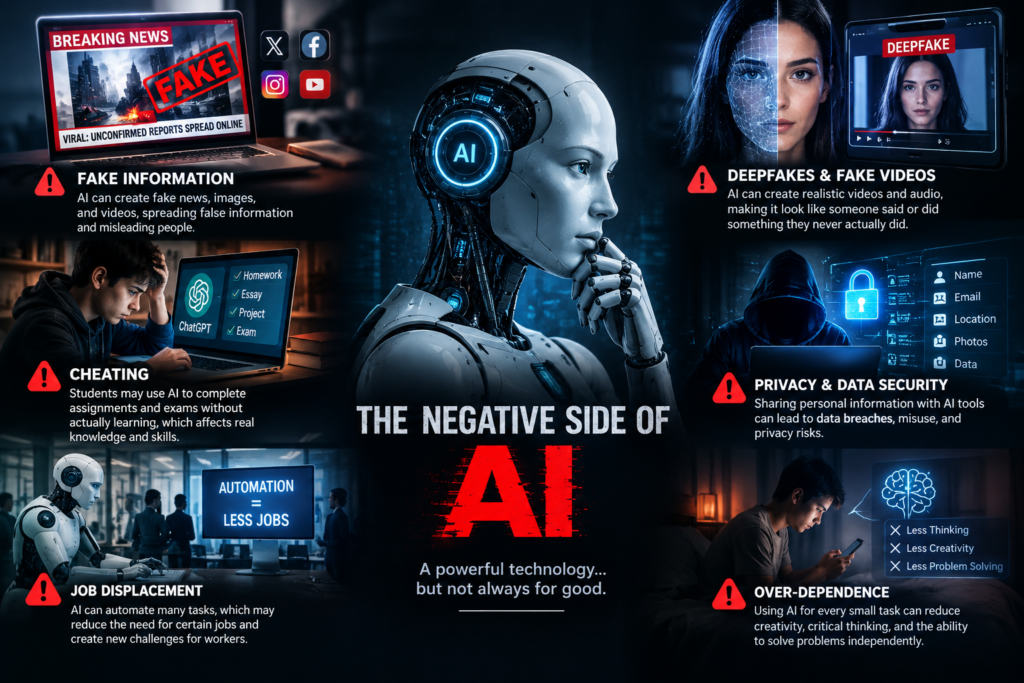
AI has many benefits, but it can also cause problems when it is misused or used without responsibility. The powerful capabilities of AI can be used to create fake content, cheat, invade privacy, and make people overly dependent on technology. Here are some major negative sides of AI.
Although Artificial Intelligence offers many benefits, it can also have negative effects when it is misused or used irresponsibly. AI can be used to create fake news, deepfake videos, misleading images, and false information that can confuse or manipulate people. Students may also use AI for cheating instead of learning, while businesses may use automation in ways that reduce the need for certain jobs. Privacy is another concern because sharing personal information with AI tools can create data security risks. In addition, depending too much on AI can reduce people's creativity, critical thinking, and ability to solve problems independently. Therefore, AI should be used carefully, with human judgment and responsibility.
1. AI Can Create Fake Information
AI can generate realistic text, images, videos, and audio within seconds. While this can be useful for creativity, it can also be misused to spread false information.
Wrong Uses:
Creating fake news
Generating misleading images and videos
Spreading false information on social media
Creating fake stories about people or events
Why it is harmful:
Fake information can mislead people, create confusion, and make it difficult to know what is real and what is fake.
2. Deepfakes and Fake Videos
AI can create realistic videos and audio that make it look like a person said or did something that never actually happened. These are commonly known as deepfakes.
Wrong uses:
Creating fake videos of celebrities or public figures
Cloning someone's voice without permission
Changing someone's face in a video
Creating fake statements or speeches
Why it is harmful:
Deepfakes can damage someone's reputation, spread misinformation, and reduce trust in online content.
3. AI Can Be Used for Cheating
AI can help students understand difficult subjects, but using it simply to complete assignments without learning can become a serious problem.
Wrong uses:
Copying AI-generated homework
Completing assignments without understanding them
Submitting AI-generated work as your own
Using AI when it is not allowed in exams
Why it is harmful:
Students may get quick answers but miss the opportunity to develop their own knowledge, creativity, and problem-solving skills.
4. AI and Job Displacement
AI can automate repetitive tasks and improve productivity, but some jobs and tasks may be affected as companies adopt more automation.
Possible Risks:
Repetitive tasks becoming automated
Some traditional job roles changing
Workers needing to learn new skills
Increased competition in certain industries
Why it is harmful:
People who do not adapt to changing technology may find it harder to compete for certain jobs. This makes learning new skills increasingly important.
5. Privacy and Data Security
AI tools can process large amounts of information. If people share personal or sensitive information without thinking about where it goes or how it is handled, privacy risks can arise.
Wrong Uses:
Sharing sensitive personal information with AI tools
Collecting personal data without proper permission
Misusing someone's information
Using AI for unauthorized monitoring or surveillance
Why it is harmful:
Personal information can be sensitive and valuable. Misuse of data can lead to privacy problems, scams, or identity-related risks.
Artificial Intelligence is a powerful technology with both positive and negative sides. It can make our lives easier, improve the way we learn and work, and help us solve many difficult problems. At the same time, its misuse can lead to fake information, privacy issues, cheating, job changes, and over-dependence on technology. Therefore, the real question is not whether AI is good or bad, but how we choose to use it. If we use AI responsibly while keeping human creativity, judgment, and values at the center, AI can become a powerful tool for building a smarter and better future.